Notes / Guide
The IB Diploma Explained | What Parents Need to Know
TL;DR
- The IB Diploma Programme (DP) is a two-year pre-university qualification for students aged 16–19, offered at over 3,500 schools in 150+ countries
- Students take six subjects, three at Higher Level, three at Standard Level, from across the arts, sciences, humanities, languages and maths. No subject group can be avoided entirely
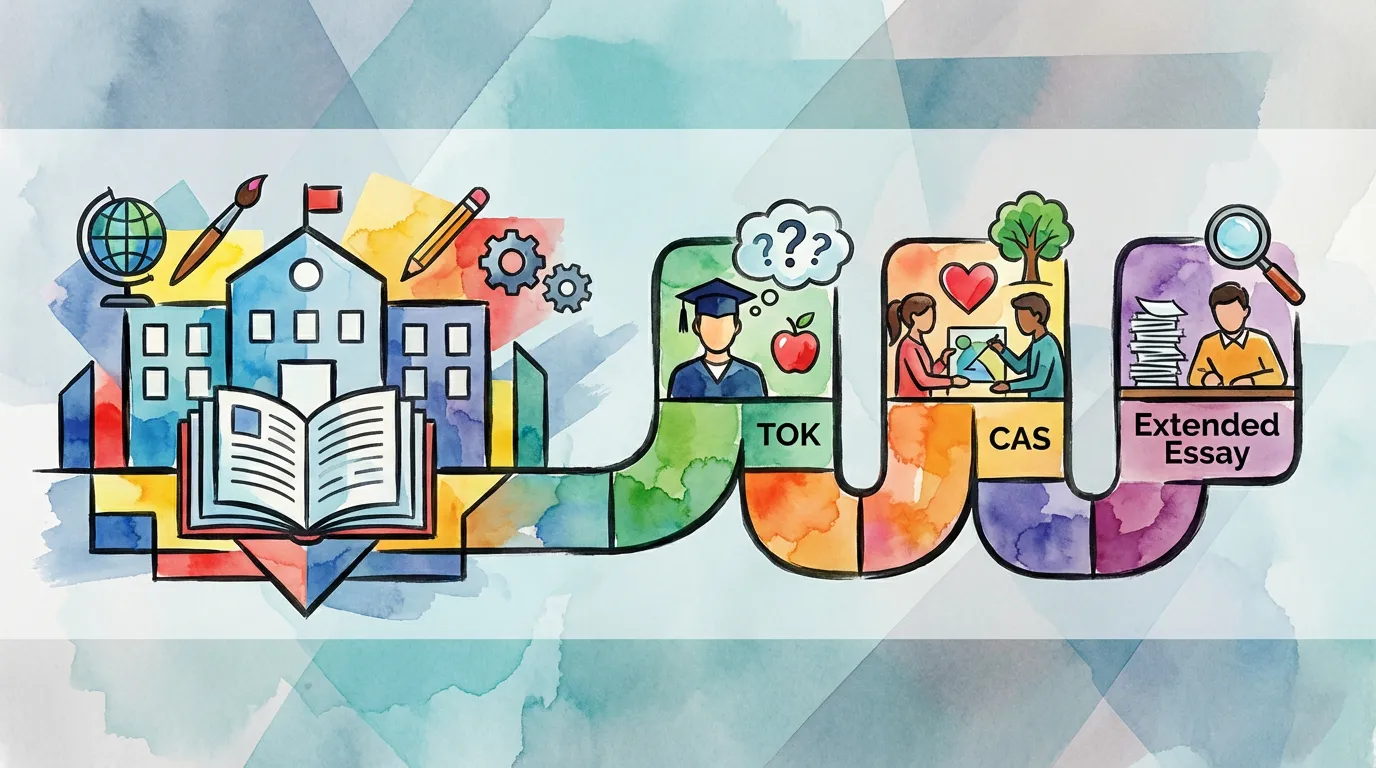
- Three compulsory core components sit on top: the Extended Essay (4,000-word research paper), Theory of Knowledge (an interdisciplinary course on how we know what we know), and CAS (150 hours of Creativity, Activity, Service)
- Scored out of 45 points. The world average is around 30–31. A score of 38+ is considered strong for competitive university applications
- The IB Diploma is not the whole IB. The IB Organisation also offers the PYP (ages 3–12), MYP (11–16) and CP (16–19). A school can offer the Diploma without running any of the other programmes, and most do
Structure, scoring, CAS, TOK, the Extended Essay, explained for parents, not educators.
The IB Diploma in 60 Seconds
The International Baccalaureate Diploma Programme was created in 1968 in Geneva. It was designed for internationally mobile families who needed a qualification that would be recognised anywhere. That problem has not gone away, and neither has the IB.
The programme runs in Years 12 and 13 (or the equivalent, IB terminology uses "Year 1" and "Year 2" of the DP). It is a full programme, not a collection of individual subject exams. You cannot pick and choose components. A student either takes the full Diploma or they do not, though some schools offer individual IB subject certificates for students who do not want the full package.
The IB Diploma is offered at over 3,500 schools in more than 150 countries. It is administered from Geneva by the International Baccalaureate Organisation (IBO), which sets syllabuses, runs external exams, trains teachers, moderates internal assessments and authorises schools to offer the programme.
Every IB Diploma exam in every subject is sat on the same date worldwide. A Higher Level Biology exam in Jakarta, Zurich and São Paulo is the same paper, marked to the same standard. This global consistency is the IB's greatest structural strength, and the reason universities trust it.
The Six Subjects
IB Diploma students choose six subjects from six subject groups:
Group 1: Studies in Language and Literature, the student's strongest language, studied at a literary and analytical level. For most international school students, this is English A.
Group 2: Language Acquisition, a second language. Options range from ab initio (beginner) to B Higher Level (advanced). Students who are bilingual can take two Group 1 languages instead.
Group 3: Individuals and Societies, humanities and social sciences. Economics, History, Geography, Psychology, Business Management, Global Politics, and others.
Group 4: Sciences, Biology, Chemistry, Physics, Computer Science, Design Technology, Environmental Systems and Societies (ESS).
Group 5: Mathematics, two routes: Mathematics: Analysis and Approaches (for students heading toward pure maths, engineering, physical sciences) and Mathematics: Applications and Interpretation (for students heading toward social sciences, business, design). Both are available at Standard and Higher Level.
Group 6: The Arts, Visual Arts, Music, Theatre, Film, Dance. Students who do not want an arts subject can replace Group 6 with an additional subject from Groups 2, 3 or 4.
Three subjects are taken at Higher Level (HL), approximately 240 teaching hours, and three at Standard Level (SL), approximately 150 hours. The choice of which subjects to take at HL is strategic and should align with university plans. A student targeting engineering will want Maths and Physics at HL. A student targeting law or PPE will want History or Economics at HL.
The Three Core Components
The IB Diploma's core is what separates it from a collection of subject exams. Three compulsory components sit alongside the six subjects:
Extended Essay (EE)
A 4,000-word independent research paper on a topic of the student's choice, within one of their DP subjects. The student works with a supervisor (a teacher at the school) over several months. The EE is assessed externally by IB examiners.
The EE is the IB's closest equivalent to university-level academic work. A strong EE demonstrates the ability to form a research question, gather evidence, build an argument and write at length. Universities, particularly in the UK, where the personal statement and predicted grades carry weight, notice a strong EE topic and take it seriously.
A weak EE, rushed, poorly supervised, or on a topic the student does not care about, teaches nothing and earns minimal marks. The quality of EE supervision varies between schools. Ask about it.
Theory of Knowledge (TOK)
TOK is the IB's most distinctive, and most polarising, component. It is an interdisciplinary course that asks students to examine how knowledge is produced and validated across different areas: natural sciences, human sciences, mathematics, the arts, history, ethics.
Students produce a TOK essay (externally assessed) and a TOK exhibition (internally assessed). The course runs throughout the two years.
TOK done well is genuinely formative. It develops critical thinking, intellectual humility and the ability to evaluate claims across disciplines. TOK done badly is abstract, disconnected from the subjects students are studying, and taught by whoever happens to have a free period. The difference comes down to the school.
Creativity, Activity, Service (CAS)
CAS requires students to engage in creative pursuits, physical activity and community service over the two years. The requirement is 150 hours total, roughly balanced across the three strands, with ongoing reflection.
CAS is not graded. It is a completion requirement, students must demonstrate sustained engagement, not excellence. In strong schools, CAS drives genuine involvement: students run clubs, coach younger pupils, organise service trips, build things. In weaker schools, CAS is a documentation exercise. Students log hours, write reflections, and learn nothing about service, creativity or themselves.
If you are evaluating an IB school, ask to see examples of CAS projects. The quality tells you something about the school's culture.
How Scoring Works
The IB Diploma is scored out of 45 points.
Each of the six subjects is graded 1–7. The maximum from subjects alone is 42.
The Extended Essay and TOK are graded together on a matrix that awards up to 3 bonus points. A student with an excellent EE and an excellent TOK result gets 3 extra points. A student with mediocre results in both gets 0.
45 is a perfect score. Fewer than 1% of candidates achieve it.
38+ is considered strong, competitive for Oxbridge, Ivy League, top Australian and Canadian universities.
34–37 is solid, sufficient for good universities in most countries.
30–33 is around the world average and meets the entry requirements of many universities.
24 is the minimum passing score. Below 24, the student does not receive the Diploma.
There are also failing conditions: a student who scores below 12 points across their three HL subjects, or below 9 across SL subjects, or who fails to complete the EE, TOK or CAS, does not receive the Diploma regardless of total points.
The IB Diploma vs A Levels vs AP: A Quick Comparison
| IB Diploma | A Levels | AP | |
|---|---|---|---|
| Subjects | 6 (3 HL + 3 SL) | 3–4 | Flexible (1–10+) |
| Core components | EE, TOK, CAS | None | None |
| Assessment | Exams + internal | Mostly exams | Exams only |
| Maximum score | 45 points | AAA* (per subject) | 5 per exam |
| Breadth vs depth | Breadth guaranteed | Depth by design | Student decides |
| Structure | Full programme | Subject-based | Subject-based |
| Global standardisation | Yes (same exams worldwide) | Varies by exam board | Yes (US-based) |
For a deeper comparison of A Levels and the IB, see IB vs A-Levels in International Schools. For how all three compare within a broader framework, see British vs IB vs American Curriculum.
PYP, MYP, DP, CP: The Full IB Family
The IB Diploma Programme is the best-known IB programme, but it is one of four. Understanding the others matters when evaluating schools.
Primary Years Programme (PYP), ages 3–12. Inquiry-led, concept-driven, organised around transdisciplinary themes. No external IB exams. Culminates in the PYP Exhibition in the final year. Quality depends heavily on teacher capability and school implementation. A school being "authorised for PYP" tells you it has met the IB's structural requirements, not that it is delivering the programme well.
Middle Years Programme (MYP), ages 11–16. Eight subject groups, conceptual framing, interdisciplinary learning, criterion-referenced assessment. Includes a Personal Project. Like the PYP, the MYP is internally assessed and school-dependent. MYP execution varies significantly between schools.
Diploma Programme (DP), ages 16–19. The programme described above. Externally examined, globally standardised, and the IB's flagship.
Career-related Programme (CP), ages 16–19. Combines IB DP courses with career-related studies and a core that includes a reflective project, service learning and language development. Less common than the DP. Offered by schools that want to provide an IB pathway for students not suited to the full Diploma's academic demands.
The key distinction: the DP is externally examined and globally standardised. The PYP and MYP are not. This means the DP delivers consistent quality worldwide (moderated by Geneva), while PYP and MYP quality depends on the school. A strong PYP school and a weak PYP school can both display the IB logo. The difference is in the classroom, not the accreditation.
A school does not need to offer PYP or MYP to offer the DP. Many schools run the English National Curriculum through to IGCSE at 16, then switch to the IB Diploma. Others run an American curriculum through to Grade 10, then add the IB Diploma as a senior option.
What Makes a Good IB School
Not all IB schools are equal. Being an "authorised IB World School" tells you the school has met the IB's requirements for running the programme. It does not tell you how well the programme is delivered.
Published results. The single most useful data point is the school's average IB Diploma score. A school averaging 34+ is delivering strong outcomes. A school averaging 28 is below the world average. Schools that publish their results are accountable. Schools that refuse to share them are asking you to trust marketing over evidence.
Pass rate, and how to read it. A 100% pass rate sounds impressive but is meaningless without context. If the school pre-selects which students enter the full Diploma, directing weaker students toward individual IB certificates instead, the pass rate is inflated. Ask how many students in the cohort started the DP and how many completed it.
EE and CAS quality. Ask to see examples. A school where students produce research on original topics with genuine intellectual engagement is doing something different from a school where every EE reads like a Wikipedia summary.
Teacher experience with IB. IB teaching, particularly at HL, requires specific training and familiarity with the assessment rubrics. Ask how many staff are IB-trained and how long the school has been offering the DP. A school in its second year of the DP is still learning. A school in its twentieth has embedded expertise.
University destinations. Where do graduates go? This is the output that matters. If the school has strong IB scores but graduates are not placing at universities that match those scores, something in the counselling or application process is not working.
Ready to explore?
FAQs
Does my child have to take the full IB Diploma? Not at every school. Many IB schools allow students to take individual IB subject certificates rather than the full Diploma. This means they sit the exam in specific subjects without completing the EE, TOK and CAS. The trade-off: individual certificates are useful but do not carry the weight of the full Diploma with universities. Students applying to competitive programmes should take the full Diploma.
Is 30 points a good score? Thirty points is the world average. It is sufficient for entry to many universities but will not open doors at the most competitive ones. A score of 34+ is strong. A score of 38+ is competitive for Oxbridge, Ivy League and equivalent programmes. Context matters, a 30 from a school that enters all students for the full Diploma is a different achievement from a 30 at a school that pre-selects.
How much does the IB Diploma cost? The IB charges schools a per-student examination fee. Schools typically pass this on to families, either built into tuition or as a separate charge. The fee varies but is typically $1,000–$2,500 for the full Diploma examination session. Some schools absorb this in tuition; others bill it separately. Ask admissions.
Can my child fail the IB Diploma? Yes. A student who scores below 24 points, or who fails specific subject minimums at HL or SL, or who does not complete the EE, TOK or CAS, does not receive the Diploma. They may still receive individual subject certificates for subjects where they achieved passing grades, but the Diploma itself is not awarded. The global fail rate is typically around 18–22% of candidates.
Is the IB Diploma recognised for university entry everywhere? Yes. The IB Diploma is recognised by universities in over 100 countries. It is particularly well understood in the UK, US, Canada, Australia, the Netherlands, Germany and Switzerland. UK universities make offers in IB points. US universities treat the IB as a rigorous college-prep programme. Specific HL subjects may be required for specific courses, check university entry requirements early.
What if my child is not academic enough for the IB Diploma? The IB Career-related Programme (CP) is designed for students who want an IB framework without the full Diploma's academic intensity. It combines DP courses with career-related studies. Not all schools offer the CP, it is less common than the DP. Alternatively, your child may be better suited to A Levels (which allow concentration in fewer subjects) or a vocational pathway.
Mia Windsor is the Managing Editor of The International Schools Guide. She covers school fees, admissions, curriculum and the practical side of choosing an international school. Follow her on Bluesky.
We work hard to make every figure, date and description on this page accurate. We don't always get it right. If you spot an error, a fee that's changed, a fact that's out of date, something we've got wrong, please tell us. Use the feedback button above or email us directly. We'll check it and update the article.