Notes / Hong Kong
Best Schools for University Placement in Hong Kong
Hong Kong is one of the world's deepest cities for university placement. Here is what separates the strongest schools, and how to read the destination lists.
The brief
- Hong Kong is one of the deepest cities in the world for university placement, with annual destination lists from HKIS, CIS, CDNIS, GSIS, Li Po Chun UWC, the ESF schools, and Kellett.
- HKIS and CIS lead for US placement, including Ivy League and equivalent. GSIS and Kellett lead for Oxbridge and Russell Group. Li Po Chun UWC sends a third of each cohort to the top thirty US universities on a near-need-blind scholarship model.
- The strongest Asian university placement is universal: HKU, CUHK, HKUST, NUS, Tsinghua, and Peking appear across almost every premium school's list.
- Debenture cost is the biggest hidden variable. A capital-note seat at CIS, GSIS or HKIS sits at HKD 1 million or more on top of fees, and the secondary-market price moves with demand.
- Read the destination list, not the highlights reel. A school that names a handful of Ivies for a cohort of 200 is showing you the ceiling, not the median.
How Hong Kong is unusual
Most international school markets have one or two schools with serious university counselling infrastructure. Hong Kong has roughly a dozen. HKIS, CIS, CDNIS, GSIS, the United World College, seven ESF schools, Kellett, Harrow, and Malvern all run dedicated college counselling teams and publish annual destination data.
The depth comes from sixty years of expat schooling, an HKDSE local system that has trained admissions officers at HKU, CUHK and HKUST to read international qualifications fluently, and a finance and law network that has kept warm relationships into top US and UK universities for a generation.
The choice, for parents, is less about whether the counselling exists and more about which system the school is set up to optimise for. A child aiming at Princeton wants a different school from a child aiming at Imperial.
How to read destination lists
Every premium Hong Kong school publishes a leavers' list. A few things to look for.
Look for the full cohort, not the highlights. A list that names Harvard, Stanford, MIT and Cambridge but does not show the other 180 students has shown nothing about the median outcome. The schools that publish all destinations (often as a multi-year aggregate) are the ones to trust.
Check the share going to Asian top-tier. HKU, HKUST, CUHK, NUS, NTU, Tsinghua and Peking are now competitive with Russell Group and second-tier US privates on most measures. A school sending 30 to 40 percent of its cohort to that group is doing well, not coasting.
Subject matters more than brand. Admission to Cambridge Engineering, UCL Economics, Imperial Medicine or NUS Computer Science is harder than admission to several Ivies for a humanities subject. A leavers' list with mixed subjects across competitive STEM courses is a stronger signal than a list of Ivy names against undifferentiated majors.
Counsellor ratio matters as much as qualification. A school with three or four full-time university counsellors for a cohort of 150 to 200 leavers can run four-year individual plans. A school with one counsellor for 500 secondary students cannot.
The strongest schools
Hong Kong International School (HKIS)
HKIS is the city's institutional anchor for US applications. American curriculum, US-style transcript, twenty-five AP courses, near-universal matriculation to tertiary, and a counselling team that has been placing Hong Kong students into US universities since 1966. Admissions officers at top US universities have decades of data on HKIS transcripts, which matters when a course average is a 92 and they need to know what that means.
The multi-year destination list shows regular placement at Harvard, Yale, Princeton, Stanford, MIT, Columbia, Penn, Duke, Northwestern, and Chicago, alongside HKU, Oxford, Cambridge, and Imperial in smaller numbers.
Strongest for: US universities, including Ivy League and small liberal arts. Strong secondary route to top UK and Asian universities.
Chinese International School (CIS)
CIS runs the full IB continuum and posted a 2025 IB average of 38.95 points with 49 percent of the cohort scoring 40 or more, one of the highest published averages in the city. The bilingual diploma stream, where students complete the IB in both English and Chinese, opens a placement route that very few schools globally can match: a marker of academic depth read by US Ivies and the top Asian universities alike.
CIS publishes destination data showing regular placement at the US top ten, Oxford, Cambridge, Imperial, UCL, LSE, HKU, Tsinghua, and Peking. The bilingual stream students are highly competitive for Tsinghua and Peking on Chinese-language entry.
Strongest for: US Ivies, top UK universities, and the top Chinese universities through the bilingual diploma route.
Canadian International School of Hong Kong (CDNIS)
CDNIS sits alongside HKIS and CIS in the historic premium tier. IB-only, with a 2025 Diploma average of 37.7 and 39.4 percent scoring 40 or more. The leavers' list shows annual placement at the US top thirty (including Ivies in most years), Oxbridge, Russell Group, McGill, Toronto, UBC, HKU, HKUST, and the rest of the Asian top tier. CDNIS also carries the deepest natural pipeline into Canadian universities of any school in the city.
Strongest for: US, UK, Canadian, and Asian top-tier universities.
German Swiss International School (GSIS)
GSIS runs both an English stream (IB, then A Level) and a German stream (Abitur). The English-stream IB averaged 40 points in 2024, one of the highest in Hong Kong, with 52 percent of A Level grades at A* or A in the same year. Russell Group placement is strong, with regular admissions to Oxford, Cambridge, Imperial, UCL and LSE. The German stream provides direct entry to German and Swiss universities under the Abitur, which is rare in Hong Kong.
Strongest for: Top UK universities through the English stream, and German and Swiss universities through the Abitur stream.
Li Po Chun United World College of Hong Kong
Li Po Chun UWC is a sixth-form-only (ages 16 to 19) IB Diploma school, around 250 students from 80 nationalities. The 2023 cohort had a quarter scoring 40 or more points and a small group at 43 and 44.
Placement is unusual: roughly a third of each cohort matriculates to the US top thirty, supported by the Davis UWC Scholars Program, which guarantees scholarships at over 90 partner US institutions for UWC graduates. LPC sends students to Yale, Princeton, Brown, Wellesley, and Williams who could not have funded a full-pay US degree from any other Hong Kong school.
Strongest for: US universities, particularly liberal arts, via the Davis Scholars route. Entry is by application and highly selective; not a like-for-like alternative to the other premium schools.
Kellett School
Kellett is the city's purest British-pathway school, IGCSE then A Level. The 2025 A Level results showed 27.5 percent of grades at A or A, 60.6 percent at A to B. The leavers' list runs heavily to Oxford, Cambridge, Imperial, UCL, Warwick, Bristol, Edinburgh, and Durham, alongside the rest of the Russell Group and the Australian Go8. For a family committed to a UK undergraduate route, Kellett is the closest match in Hong Kong on curriculum, school culture, and counselling track record.
Strongest for: Oxbridge and Russell Group. Also strong for Australian and Asian top-tier universities.
The ESF schools
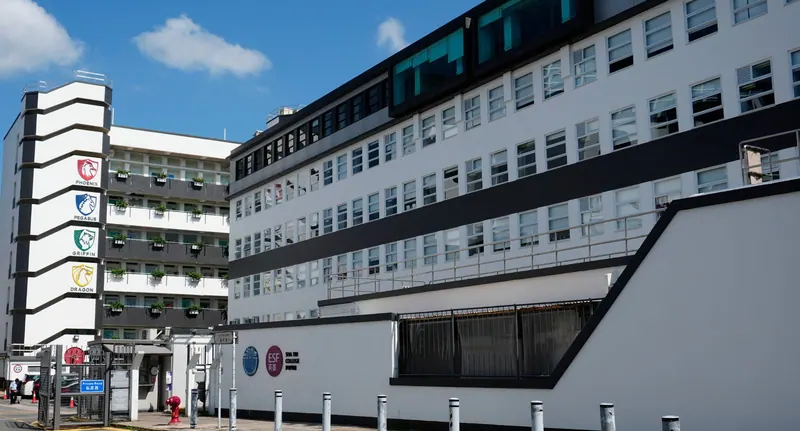
The English Schools Foundation runs several secondary schools with strong published IB results: West Island School (37.6 average, 38 percent at 40+ in 2025), Sha Tin College (37.2, 41 percent at 40+), Island School (36.5), Renaissance College (36), King George V (36.1), and South Island School (35.9). Cohorts run 150 to 250 leavers per school, which gives the counselling teams genuine data on what a given grade profile produces in offers.
ESF placement is strong across UK, Asian, and Australian universities, with annual representation at Oxbridge, Russell Group, HKU, HKUST, CUHK, NUS, and the Go8. US placement is more variable; West Island and Sha Tin tend to be the strongest US senders in the system.
Strongest for: UK Russell Group, Australian Go8, and the Asian top tier. A meaningful step down in fees from the historic premium tier without a corresponding step down in placement breadth.
Other schools with credible records
Malvern College Hong Kong posted a 2025 IB average of 44 on an early small cohort. Australian International School runs the HSC and IB (41 percent at 40+) and is the natural route to the Australian Go8. Harrow Hong Kong put 33 percent of 2025 A Level grades at A and 70 percent at A or A. The ISF Academy reported 94 percent of 2025 leavers matriculating to a world top-100 university. Singapore International School sits at 39.2 IB. French International School places students into the French Grandes Écoles via the Bac.
At a glance
| School | Curriculum | 2024-25 headline | Cohort scale | Debenture |
|---|---|---|---|---|
| Hong Kong International School | American (AP) | Near 100% to tertiary; 25 APs offered | ~3,000 total | Capital levy required |
| Chinese International School | IB | IB avg 38.95; 49% at 40+ | ~1,600 total | Capital note required |
| Canadian International School | IB | IB avg 37.7; 39% at 40+ | ~2,200 total | Capital levy required |
| German Swiss International School | IB + A Level + Abitur | IB avg 40; 52% A* or A at A Level | ~1,300 total | Capital certificate required |
| Li Po Chun UWC | IB (16 to 19 only) | 25% at 40+; Davis Scholars route | 250 total | None; need-blind admissions |
| Kellett School | British (A Level) | 27.5% A at A Level; 60.6% A or A | ~1,600 total | Capital levy required |
| West Island School (ESF) | IB | IB avg 37.6; 38% at 40+ | ~1,200 secondary | Capital levy required |
| Sha Tin College (ESF) | IB | IB avg 37.2; 41% at 40+ | ~1,400 secondary | Capital levy required |
| King George V School (ESF) | IB | IB avg 36.1; 29% at 40+ | ~2,000 secondary | Capital levy required |
| Harrow International School | British (A Level) | 33% A; 70% A or A at A Level | ~1,700 total | Capital levy required |
| Malvern College Hong Kong | IB | IB avg 44; 60% at 45 (small cohort) | ~1,100 total | Capital certificate required |
| Australian International School | IB + HSC | IB avg 38; 41% at 40+ | ~1,200 total | Debenture required |
Headline figures are the most recent published results from each school. Debenture and capital-note structures vary by school and by year; the secondary-market price for tradable notes is not the same as the school's nominal issue price.
What to watch for
Highlights reels versus full lists. A "Class of 2025 destinations" poster with the Ivy logos picked out has answered a marketing question, not a parent question. The full cohort breakdown across multiple years is the document that matters.
Counsellor experience. A counsellor who has placed students into HKU, Yale, Cambridge and NUS for ten years carries institutional relationships a new hire cannot replicate in a year.
System fit. A US-pathway school is not the right home for a child applying to UK medicine. The strongest school in the wrong system will lose to a mid-tier school in the right one.
Debenture timing. Premium-tier seats at CIS, HKIS, CDNIS, GSIS and several ESF schools require a capital contribution that runs into seven figures HKD. Families weighing a move late in primary or early in secondary should budget for the debenture as part of the placement decision, not separately.
Bilingual capacity. The bilingual IB diploma at CIS, and Chinese-language depth at CDNIS, ESF, and ISF, is now a genuine differentiator on Tsinghua, Peking, HKU, and CUHK applications.
Related reading
- Best international schools in Hong Kong
- Top 10 international schools in Hong Kong
- Best IB schools in Hong Kong
- International school fees in Hong Kong
FAQs
Does the school matter more than the qualification? Both matter. A 42-point IB or four-A* A Level set is competitive everywhere regardless of school. What the school adds is counselling, predicted grades that admissions officers trust, reference letters with weight, and the institutional familiarity that pushes a borderline application across the line.
Can a student from outside the premium tier still place into a top university? Yes. ESF schools, ISF Academy, Australian International, Singapore International, and Malvern have all sent students to Oxford, Cambridge, Ivies, and the Asian top tier in recent years. The route is real; the support is thinner, and families often supplement with external counselling.
Is the IB or A Level a better route for Oxbridge? Either works. Oxbridge admits roughly the same proportion of IB and A Level applicants when grade equivalents are matched (38 to 40 points IB or AAA at A Level, depending on course). Subject combination and interview performance matter more than the qualification itself.
Are HKU, CUHK and HKUST realistic targets from an international school? Yes, and increasingly so. All three accept IB, A Level and AP results directly, and admissions officers read predictions from the major Hong Kong international schools accurately. For STEM and business, HKU and HKUST are competitive with Russell Group on faculty and graduate outcomes.
Is the Davis Scholars route at Li Po Chun a realistic plan? For a strong student who can win a place at LPC (selective in itself), yes. The Davis programme guarantees scholarships at over 90 partner US institutions for UWC graduates, which can convert a USD 350,000 four-year US private undergraduate cost into a fundable route.
Sources
- HKIS leavers' destinations (multi-year), hkis.edu.hk
- CIS 2025 IB Diploma results and university destinations, cis.edu.hk
- CDNIS 2025 IB Diploma results, cdnis.edu.hk
- GSIS 2024 IB and A Level results, gsis.edu.hk
- Li Po Chun UWC 2023 IB results; Davis UWC Scholars Program, lpcuwc.edu.hk and davisuwcscholars.org
- Kellett School A Level and GCSE results 2025, kellettschool.com
- ESF results pages for West Island, Sha Tin, Island, King George V, South Island, Discovery and Renaissance Colleges, esf.edu.hk
- Harrow International School Hong Kong A Level results 2025, harrowschool.hk
- Malvern College Hong Kong 2025 IB results, malverncollege.org.hk
- Australian International School, ISF Academy, Singapore International School, French International School Hong Kong: 2024-25 results pages
We work hard to make every figure, date and description on this page accurate. We don't always get it right. If you spot an error, a fee that's changed, a fact that's out of date, something we've got wrong, please tell us. Use the feedback button above or email us directly. We'll check it and update the article.