Notes / Jakarta
Where Did Obama Go to School in Jakarta?
Two Jakarta schools claim Barack Obama. One taught him for nearly three years. The other for about a year and a half. The shorter stint won the PR war.
TL;DR
- Barack Obama attended two primary schools in Jakarta between 1968 and 1971: Santo Fransiskus Asisi, a Catholic school in Menteng Dalam, for nearly three years; and SDN Menteng 01 (Besuki), a state school in upscale Menteng, for about a year and a half.
- Besuki has the photographs, the alumni network, the bronze statue, and the spot on every official itinerary. It is what Google calls "Obama's school" today.
- Asisi has a register, a stern Dutch priest, and the longer claim. It was not on Obama's itinerary when he returned to Jakarta in 2017.
- Neither school was a madrassa, despite the rumour that briefly tried to make it so during the 2008 American presidential campaign.
The Two Schools That Claim Barack Obama
Barack Obama went to two schools in Jakarta. One taught him for nearly three years. The other for about a year and a half. Ask Google which was "Obama's school" and you'll get the wrong answer.
Jakarta, 1967: no electricity, 600% inflation, and the first foreigners on the street
Ann Dunham met Lolo Soetoro at the University of Hawaii. He was an Indonesian geography student on a government scholarship. They married in 1965, and then things got complicated.
Back in Indonesia, the army had overthrown President Sukarno after a failed coup attempt in 1965. What followed was one of the twentieth century's worst political purges. Hundreds of thousands of suspected communists were killed. Every Indonesian student studying abroad was recalled. Lolo's passport was revoked. He went home, and Ann and her six-year-old son waited in Hawaii for over a year while the paperwork was sorted out.
They landed in Jakarta in 1967. Walking off the plane, Obama later wrote, he felt "the tarmac rippling with heat, the sun bright as a furnace." He clutched his mother's hand, determined to protect her.
The Jakarta they found was not the megacity it is today. Suharto had taken power barely a year earlier. Inflation was running above 600%. The skyline was dotted with the steel skeletons of Sukarno's unfinished monuments. Lolo's house, in the Menteng Dalam neighbourhood on the outskirts of the city, had no electricity. The streets were unpaved. The backyard was occupied by two baby crocodiles, along with chickens and birds of paradise.
Ann and Barry were the first foreigners the neighbourhood had ever seen. To make friends with the kids next door, the six-year-old sat on the wall between the two houses, flapped his arms like a giant bird, and made cawing noises. The children laughed. Then they played together. He ate tofu and tempeh like everyone else, played soccer in the street, and picked guavas from the trees. The neighbourhood kids called him "Negro." He seemed to shrug it off.
Ann took a job teaching English at the American embassy. She couldn't afford the elite international school, and she worried her son wasn't being challenged enough at the local schools. Her solution was to wake him at 4am every morning and teach him English herself, using a correspondence course from the Calvert School in the United States. This went on for the entire time they lived in Jakarta. Obama, by his own account, was not enthusiastic.
Meanwhile, Lolo rose through the ranks of an American oil company and moved the family upmarket to Menteng, one of Jakarta's wealthiest districts. It was a different world from Menteng Dalam. And it meant a different school.
The Catholic school down the narrow lane vs the elite school near the ambassador's residence
When Ann couldn't afford international school, she enrolled her son at a Roman Catholic primary school in Menteng Dalam called Santo Fransiskus Asisi. The school sat down a narrow, winding lane, hidden behind a big church. It was run by a stern Dutch priest. The pupils were the children of farmers, servants, tailors, and clerks. Most of them, Obama's neighbour Indra Madewa later remembered, came to school in shoes. Obama went barefoot or in sandals.
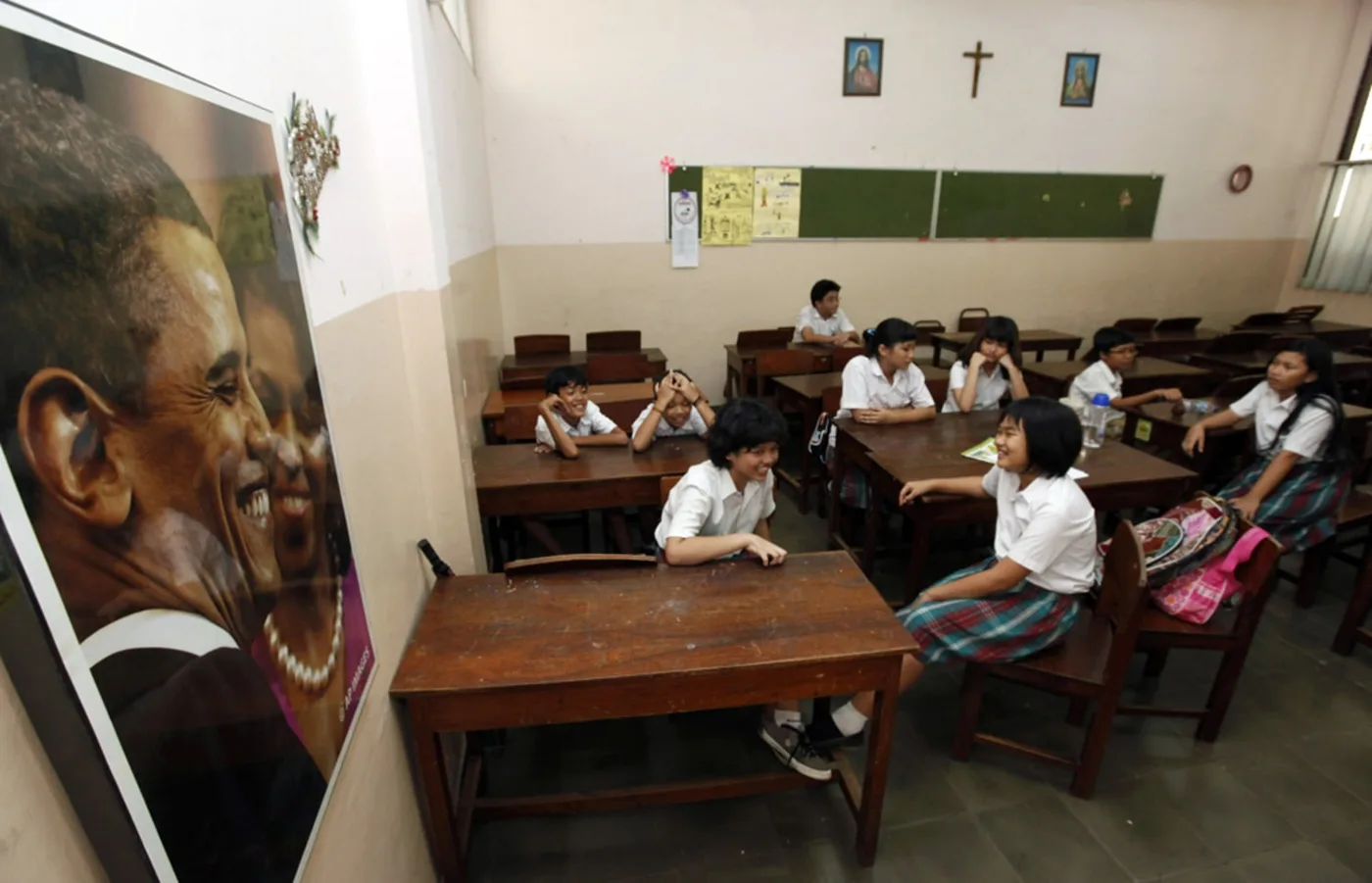
The school register, still kept by the school today, records his entry on 1 January 1968. First grade. Name: "Barry Soetoro." Religion: Islam. He was registered as Muslim because that was Lolo's faith, and because that was the box his stepfather ticked. It made no difference to the daily routine. Every student at Asisi, regardless of faith, attended Christian services. Classes began and ended with Christian prayers.
He stayed at Asisi for nearly three years. There are no photographs of him from this period. "Nobody had a camera back then at Asisi," a former classmate, Nurmaria Sarosa, later told reporters. The school had no plaque, no statue, no photo wall. What it had was a register, a memory, and a claim.
Sometime in the third grade, after Lolo's promotion at the oil company moved the family to wealthier Menteng, Obama transferred to SDN Menteng 01, known locally as Besuki. The contrast was hard to miss. Besuki had been founded under Dutch colonial rule as an elite school for the children of officials and businessmen. It sat a short walk from the residence of the United States ambassador. Its alumni would go on to run airlines, banks, and parts of the Indonesian parliament.
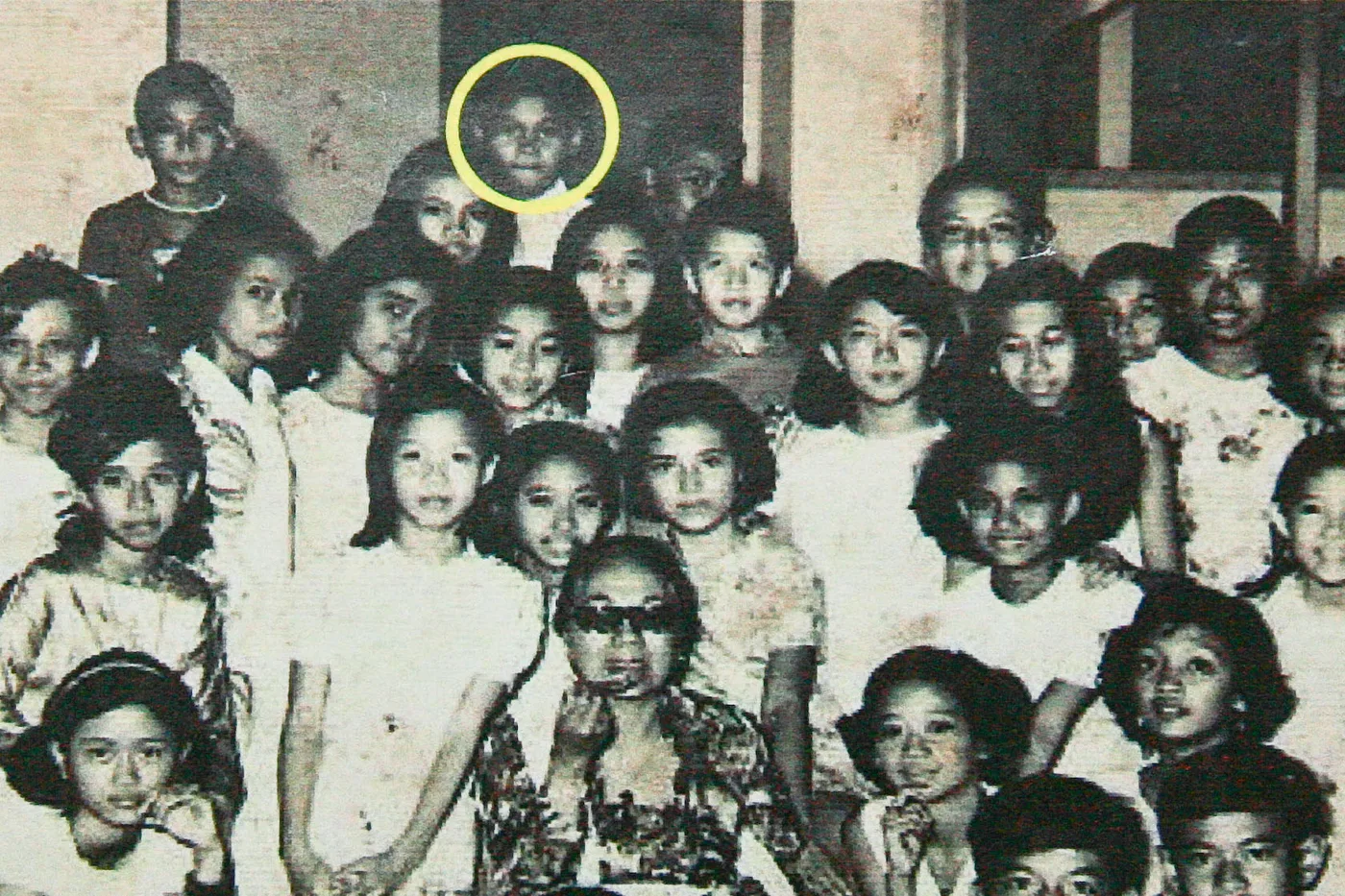

Besuki was, technically, a state school. It had a mosque on the grounds. Religious instruction included Islam, and Obama, registered as Muslim, took part. A classmate, Rully Dasaad, later recalled the boy who horsed around in class and got laughed at for his pronunciation during Koran readings. Dasaad's family, for context, owned one of the only two Cadillacs in Jakarta in the 1960s. The class divide between Asisi and Besuki was not subtle.
Obama spent about a year and a half at Besuki before his mother put him on a plane back to Hawaii in 1971. He was ten years old. Records that might have pinned down the exact months of his attendance were destroyed years later in a flood.
This is the part of the story that, decades later, would become a small political problem. During the 2008 American presidential campaign, a rumour circulated that Obama had attended a "radical Muslim madrassa" in Indonesia. The reality was stranger and more interesting than the rumour. He had attended a Catholic school run by a Dutch priest where everyone prayed Christian prayers, and a state school with a mosque where everyone learned the national anthem. Both schools educated children of every major Indonesian faith. Neither was a madrassa. The rumour died, but it would help explain why one of the two schools, decades later, would work so hard to claim him.
How Besuki won the PR war, and Asisi fought back
By the time Obama announced his run for the presidency in 2007, the question of where he had gone to school in Jakarta had become a matter of some local importance. Besuki moved first, and moved hard.
The school dug out its photographs of Obama as a fourth-grader. It put them on display. It produced a plaque. It cultivated its alumni network, which by then included airline chiefs, parliamentarians, and the head of Indonesia's mint. When Hillary Clinton arrived in Jakarta as Secretary of State in February 2009, Besuki sent representatives to greet her at the airport. When the United States ambassador wanted to visit a school connected to the new president, Besuki was on the itinerary. When Obama's first presidential trip to Indonesia was being planned, Besuki was on the itinerary for that too.
The centrepiece of the campaign was a bronze statue. It was commissioned by an American expatriate named Ron Mullers, who ran Mexican restaurants in Jakarta and had founded a group called the Friends of Obama Foundation. The statue depicted a ten-year-old Obama, smiling, with a butterfly perched on his outstretched thumb. It was based on a childhood photograph. Mullers paid US$10,000 for it.
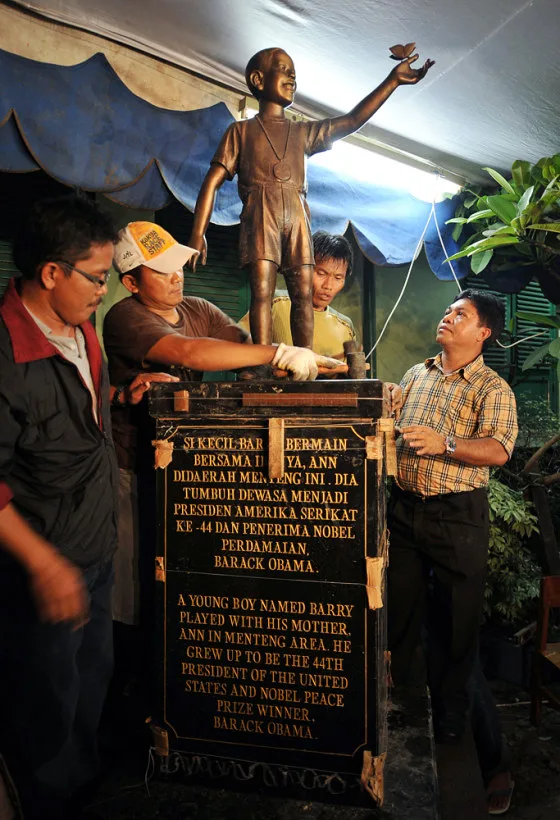
In December 2009, Jakarta's mayor unveiled the statue in Taman Menteng, a public park near Besuki. A crowd of about 500 watched, including scores of proud Besuki students. The unveiling did not go as planned.
Within days, an Indonesian-language Facebook group called "Take Down the Barack Obama Statue in Taman Menteng Park" began collecting members. By early 2010 it had passed 50,000. The objection was not, mostly, about Obama. It was about the principle. Indonesia had its own heroes, the campaigners argued, and many of them were not yet immortalised in bronze. Why should a foreign president have a public monument before they did? Court action was filed. The Jakarta city government, sensing where the wind was blowing, agreed to remove it.
On a Sunday night in February 2010, the statue was lifted out of the park and trucked across town to Besuki. Three labourers set it in wet concrete in the school courtyard, finishing before the students arrived on Monday morning. Mullers said it was not an attempt to keep a low profile. The relocation, with sponsors covering the additional cost, brought the total bill to US$50,000. "It wasn't cheap," Mullers told reporters, "but I'm glad it's now in the best place for it."
For Asisi, watching all this unfold, the situation was infuriating. Obama had spent nearly three years in their classrooms and less than one in Besuki's. Besuki had the statue, the photographs, the visits, the headlines. Asisi had a register and a stern Dutch priest who was no longer there to vouch for it.
The school's principal, Yustina Amirah, summed it up in five words: "They are very good at marketing."
A counter-campaign began. Boy Garibaldi Thohir, an Asisi graduate who had gone on to run an energy company, started organising. Indra Madewa, Obama's old neighbour and barefoot playmate, joined in. They wrote letters to the White House, the State Department, and the American embassy in Jakarta. They produced a video. Karen Brooks, a friend of Thohir who had worked on the National Security Council, gave them tips on how to pitch the story. "This is not fair," Thohir told reporters. "Facts are facts."
The facts were on Asisi's side. The marketing budget was on Besuki's. By the time the dust settled, the world had largely decided that Besuki was Obama's school. Type the question into Google today and Besuki is what comes back.
"It seems like only yesterday": Obama's return
He did come back. In June 2017, five months after leaving the White House, Barack Obama brought his family to Indonesia for a ten-day private holiday, mostly built around Bali and Yogyakarta. He used part of the trip to revisit Jakarta, including a quiet stop at his old school: SDN Menteng 01. He met some of his former teachers. He did not visit Asisi.
Asisi found out about the visit the way everyone else did, which was from the news. The principal made no public comment. Indra Madewa, Obama's old neighbour, told a local reporter that he understood why the visit had gone the way it had. Besuki was the school the protocol office knew. It was the school on the official record. It was the school with the statue.
Years earlier, when a Besuki classmate had sent some old photographs to the White House, Obama had written back. "I enjoyed your photos," the note read. "It seems like only yesterday I was playing with my classmates in Jakarta."
Yesterday, in this case, was Menteng Dalam in 1968. A six-year-old Barry Soetoro on a wall, flapping his arms like a bird to make the neighbourhood children laugh. A barefoot walk down a narrow lane to a Catholic school run by a stern Dutch priest. A register that listed his religion as Islam and a morning prayer that was Christian. Three years that left no photographs and no statue, but did leave the version of him that he wrote about, decades later, when he tried to explain to the world who he was.
The school that spent less time with him won the last word. The school that spent the most still has the register, the lane, and the church at the end of it. Both schools are still there. Both schools still claim him. And the question, when you type it into Google, still has more than one answer.