Notes / Dubai
Best Schools for EAL Support in Dubai
KHDA inspects EAL as part of inclusion. Shortlist: JESS, Repton, Brighton, Wellington, NLCS, plus the named national-language schools.
The brief
- KHDA treats EAL as part of inclusion. Every DSIB report carries an Inclusion of students of determination rating, and EAL learners are named inside that frame.
- Strongest mainstream EAL provision: JESS Arabian Ranches, Repton Dubai, Brighton College Dubai, GEMS Wellington International and North London Collegiate School Dubai. All hold a KHDA inclusion read of Outstanding or Very Good with named EAL staffing.
- Demand is shaped by the language profile of the city. Arabic, Russian, Chinese, Korean and Japanese home-language families are the largest non-English cohorts; strong EAL departments are sized for them.
- Home-language continuity sits with the national schools: Lycée Français International, Deutsche Internationale Schule, the Dubai Japanese School, the Russian International School. These keep the mother tongue intact while the child reads in their first language.
- EAL is usually charged separately. Expect a tiered fee on top of tuition for the first year or two, lifted once the school's exit framework confirms the child can access the curriculum unsupported.
A child arriving in Dubai mid-year with limited English lands in a city built around this case. Around two hundred nationalities sit inside the private school system. The Knowledge and Human Development Authority (KHDA) licenses and inspects every private school annually through the Dubai Schools Inspection Bureau (DSIB), and EAL provision is one of the lines inspectors look at, inside the inclusion frame.
This guide reads the KHDA inclusion line, the named EAL staffing, and the families each school is sized to receive.
What good EAL provision looks like
An EAL learner is a child reading maths, science, humanities and English itself in their second or third language. The cognitive load is real and runs for years.
The research literature splits the timeline cleanly. Conversational fluency lands inside 18 to 24 months for most children with average cognitive development. Academic English (analytical essays, exam questions) takes 5 to 7 years. A school that promises full fluency inside a year is describing the first; the second decides IGCSE and IB results.
Strong EAL provision does two things at once. It accelerates English acquisition with a named specialist on staff and a framework with entry and exit criteria. It also keeps the child inside the academic curriculum while the English develops, through in-class push-in by an EAL specialist working with the subject teacher and differentiated assessment. A school that does only the first runs language lessons in a vacuum; a school that does only the second leaves academic English to chance.
How to read claims of EAL support
KHDA expects every licensed private school to support EAL learners. Provision varies. Three filters separate the structural programmes from the marketing line.
The KHDA inclusion line. EAL learners are named explicitly inside the inclusion frame in the DSIB framework. Schools rated Outstanding or Very Good for inclusion are the meaningful tier; reports name the EAL cohort, sometimes with a percentage. The headline rating can mask a thin EAL bench.
Named EAL staffing. Strong programmes publish a Head of EAL or EAL Lead at senior level, with specialist teachers on the staff list. Thin programmes mention "EAL support available" without a named role.
Entry assessment and exit criteria. A structured programme runs a formal language assessment on entry, typically against the WIDA framework or Cambridge English proficiency levels, places the child in a banded support tier, and names the threshold at which support is withdrawn.
The strongest mainstream EAL provision
These five combine a KHDA inclusion read of Outstanding or Very Good with published EAL infrastructure and a long enough run of cohorts to read the work. Fit between them is curriculum, area, and the size of the home-language community a child lands into.
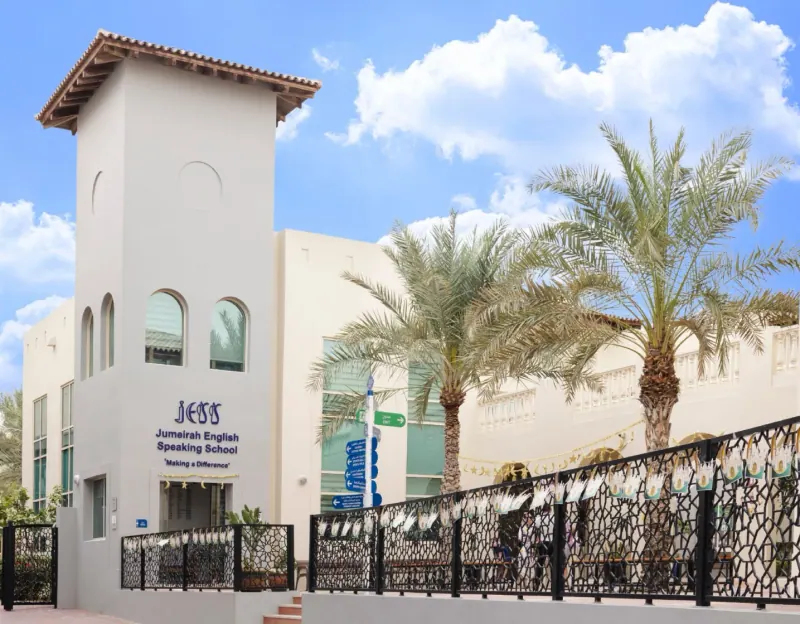
Jumeirah English Speaking School, Arabian Ranches (JESS AR)
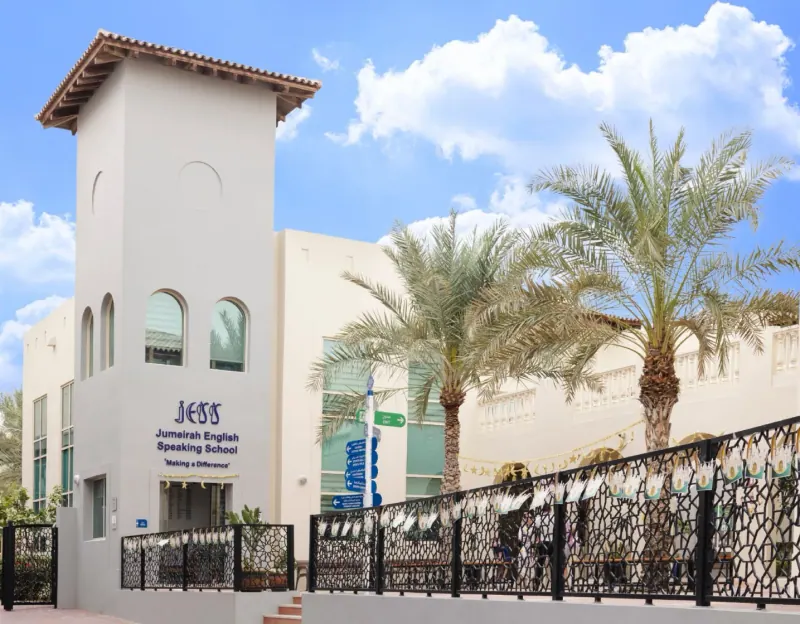
Arabian Ranches. Ages 3 to 18. Fees AED 54,129 to 104,544. Founded 1976. BSO Outstanding, COBIS, IAPS, HMC. Around 750 pupils.
The oldest British school in the emirate runs EAL through a central Learning Support department at the same scale as its academic faculties. The IAPS and HMC memberships are unusual in the region and translate into staffing depth. Continuity from FS1 through sixth form keeps the child's record inside one team from arrival to IB Diploma access arrangements.
Repton School Dubai
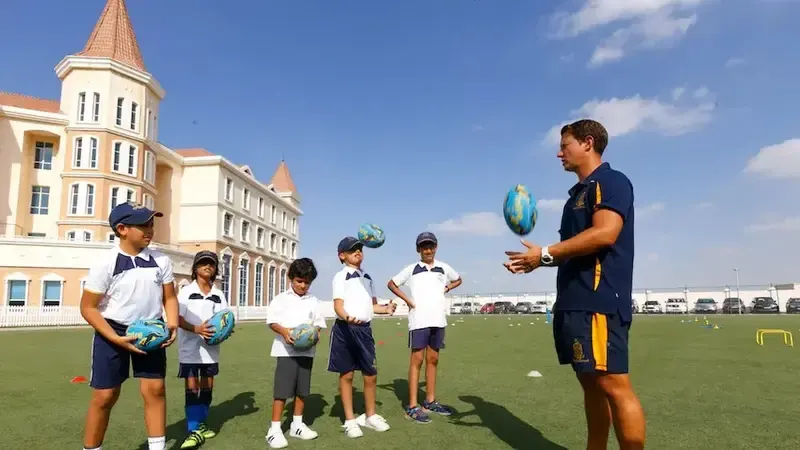
Nad Al Sheba. Ages 3 to 18. Fees AED 57,178 to 102,753. Founded 2007. BSO accredited, COBIS member. Around 1,800 pupils.
Repton's Wellbeing and Inclusion function sits at senior leadership level, with EAL staffed inside it as a structural department. The senior route is IB Diploma only, which routes EAL students into the IB's language A self-taught option for students who want to sit a language A in their mother tongue while taking English at language B. The cohort is large enough to make this routine.
Brighton College Dubai
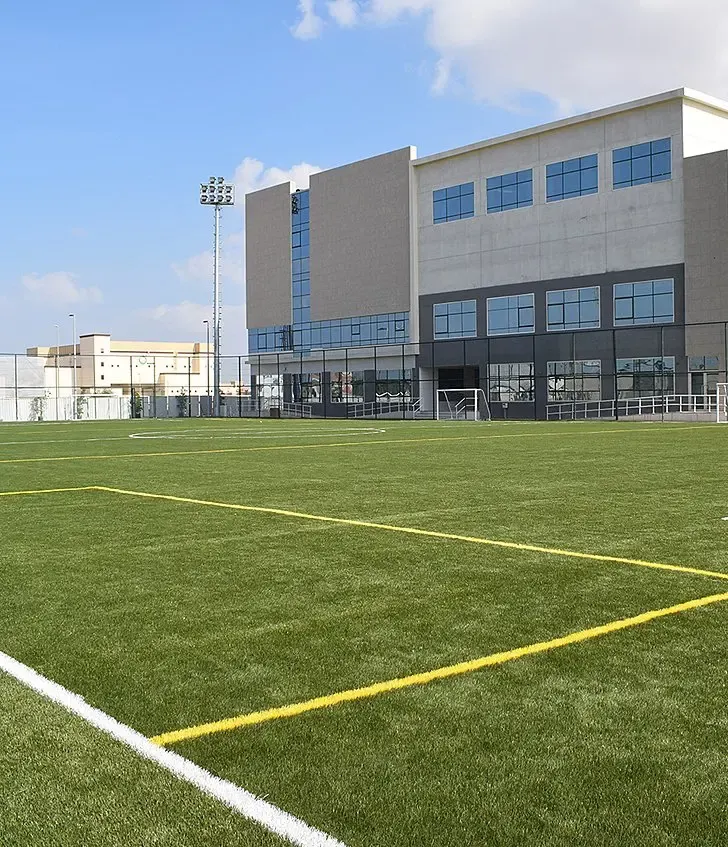
Al Barsha. Ages 3 to 18. Fees AED 64,175 to 105,773. Founded 2018. BSO/COBIS Outstanding 2025. Around 1,500 pupils.
Brighton's UK parent sets the model: a senior Director of Learning Development, in-house specialists, EAL screening built into the admissions assessment, and JCQ access arrangements managed in-house for A-Level candidates whose English is still developing. Senior route is A-Level only; families looking at IB DP route to Repton or Wellington.
GEMS Wellington International School (WIS)
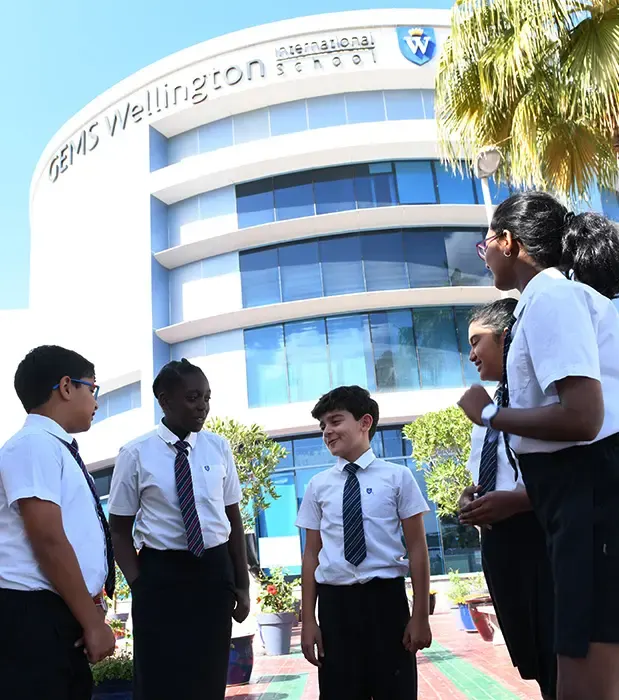
Al Sufouh. Ages 3 to 18. Fees AED 47,527 to 103,399. Founded 2005. BSO Outstanding, COBIS Patron's Accreditation Beacon Status. Around 2,900 pupils.
Wellington is the largest senior school on this shortlist and offers dual A-Level and IB Diploma. Scale gives the deepest bench: a multi-specialist EAL department, push-in support inside mainstream classes, and a published banded entry framework. The home-language cohorts are correspondingly large; a Russian or Mandarin speaker arriving in Year 7 will find peers in the same position. Larger year groups carry a more institutional feel.
North London Collegiate School Dubai (NLCS)

Nad Al Sheba. Ages 3 to 18. Fees AED 91,735 to 143,681. Founded 2017. BSO, KHDA Outstanding. Around 1,600 pupils.
NLCS sits at the top of the Dubai fee curve and is selective. EAL inside that frame is built for academically able children with limited English, often arriving from East Asia, Central Asia or the CIS. Entry assessment runs against the WIDA framework and an in-house EAL team integrates with the IB MYP and DP. The school's claim is full curriculum access during acquisition, not a separate track.
At a glance
| School | Area | KHDA inclusion read | Curriculum | Ages | Fees AED |
|---|---|---|---|---|---|
| JESS Arabian Ranches | Arabian Ranches | Very Good | British and IB | 3 to 18 | 54,129 to 104,544 |
| Repton Dubai | Nad Al Sheba | Very Good | British and IB DP | 3 to 18 | 57,178 to 102,753 |
| Brighton College Dubai | Al Barsha | Very Good | British | 3 to 18 | 64,175 to 105,773 |
| GEMS Wellington International | Al Sufouh | Very Good | British and IB | 3 to 18 | 47,527 to 103,399 |
| North London Collegiate Dubai | Nad Al Sheba | Outstanding | British and IB | 3 to 18 | 91,735 to 143,681 |
| American School of Dubai | Al Barsha | Very Good | American | 3 to 18 | 60,571 to 102,303 |
| Kings' Al Barsha | Al Barsha South 1 | Outstanding | British | 3 to 18 | 57,999 to 105,873 |
| GEMS Modern Academy | Nad Al Sheba | Outstanding | IB and Indian | 3 to 18 | 30,983 to 73,876 |
| Dubai British School Mira | Mira | Very Good | British | 3 to 11 | 51,477 to 77,217 |
| GEMS Founders Dubai South | Dubai South | Very Good | British | 3 to 14 | 36,400 to 50,400 |
| The Aquila School | Wadi Al Safa | Good | British | 3 to 18 | 48,673 to 77,876 |
Fees are 2025-26 top-year ranges as published by each school. The KHDA inclusion line changes annually with each DSIB inspection cycle; verify the current rating on the KHDA inspection reports site before committing.
Home-language continuity: the national schools
Families whose first priority is keeping the mother tongue and home curriculum intact while the child picks up strong English are usually better served by a national-system school. These run in the home language with English as a structured second language.
- Lycée Français International de Dubaï (LFI), Oud Metha. French national curriculum from maternelle through baccalauréat; the largest francophone school in the emirate.
- Lycée Français Jean Mermoz (LFJM), Nad Al Sheba. French bilingual route with Cambridge IGCSE and IB Diploma layered on at senior.
- Deutsche Internationale Schule Dubai, Academic City. German national curriculum, Excellent German School Abroad designation.
- Dubai Japanese School. Japanese national curriculum; oriented to the corporate-relocation Japanese community.
- Russian International School in Dubai, Muhaisanah. Russian national curriculum; the Saturday Russian-language classes are open to Russian-speaking children attending other Dubai schools.
The decision is structural. A French family planning a return to Paris in three years is better served by LFI even if NLCS would also have taken the child. The English-medium British and American schools become the right call when the likely next move is to an English-speaking university or another English-medium posting.
What to watch for
The EAL fee bracket. Most schools tier the EAL fee at three levels (light, moderate, intensive) and lift it once the child meets the exit threshold. The published schedule, not the admissions tour, is where the school commits in writing.
Cohort size for the home language. A Korean six-year-old arriving at a school with eight other Korean families is in a structurally different position from the same child arriving alone. The question is direct: how many children from this home-language background are currently in this year group.
Exit framework. Schools that name a framework (WIDA Levels 1 to 6, Cambridge English A1 through C1, or an equivalent) are reading the same child against the same yardstick across years. Schools that exit on teacher judgement are running an open-ended relationship.
Senior exam access arrangements. IGCSE, A-Level and IB Diploma candidates whose English is still developing are entitled to specific arrangements (extra time, dictionary in some subjects, separate room). These run under JCQ for British qualifications and the IB Diploma inclusive assessment policy for IB. A school that holds the evidence file in-house applies them more consistently than a school that outsources access at exam season.
Related reading on The Guide
- Best international schools in Dubai (pillar)
- Best British schools in Dubai
- Best IB schools in Dubai
- Best schools for SEN and learning support in Dubai
- International school admissions in Dubai
- International school fees in Dubai
FAQs
How long until my child is fluent in English?
Conversational fluency lands inside 18 to 24 months for most children with average cognitive development and regular exposure. Academic English takes 5 to 7 years. Schools that promise full fluency inside a year are describing the first milestone; the second decides academic outcomes.
Will EAL cost extra on top of tuition?
Usually, yes. Most Dubai schools tier the EAL fee at three bands (light, moderate, intensive) for the first year or two and lift it once the child meets the exit threshold. Indicative ranges run AED 4,000 to 10,000 light, AED 10,000 to 25,000 moderate, and AED 25,000 to 50,000 intensive. A small number of schools fold EAL into tuition; the published fee schedule confirms which.
Can my child sit an IB Diploma subject in their mother tongue?
Yes. The IB Diploma allows a language A self-taught at standard level for languages the school does not teach as a taught subject, with assessment routed through the DP coordinator. Several Dubai schools also offer language A: language and literature in widely spoken languages (Arabic, French, Russian, Mandarin, German, Spanish, Hindi). Raise it with the DP coordinator a full year before subject choices are due.
Should I choose a national-language school instead?
Family-dependent. Three factors decide it: likely length of stay in Dubai, the next destination, and the strength of the home language the family wants the child to retain. A French family on a three-year posting expecting a return to France is structurally better served by LFI. A Korean family on a long horizon with university aimed at the US or UK is structurally better served by an English-medium school with strong EAL.
What does the KHDA inclusion line tell me about EAL specifically?
The DSIB inclusion section names the EAL cohort, often gives a percentage, and comments on identification, support and progress monitoring. A school rated Outstanding or Very Good provides structured support that meets or exceeds the policy framework. Acceptable clears the floor; the work below the line is thinner.
Sources: KHDA Dubai Inclusive Education Policy Framework (2017, revised 2020), DSIB annual inspection reports for each named school, school EAL and inclusion policies as published, and ISG verified profile data. Fee figures are 2025-26 top-year ranges as published by each school. Verify the current KHDA inclusion rating and EAL fee schedule directly with each school before committing.