Notes / Bangkok
Bangkok: Best IB Schools (Results, Fees, Rankings)
A data-led ranking of Bangkok's IB Diploma schools by average score, fees, and value, with full results tables for the nine schools where we found published data.

TL;DR
- Bangkok has 17 international schools offering the IB Diploma. Fees range from US$5,000 to US$31,000 per year for the oldest year groups. We could find published results for nine of them.
- NIST leads the city with a 37-point average (Class of 2025, cohort of ~110) and is the only Bangkok school ranked in the global top 100. Concordian (36) and Bangkok Patana (35, non-selective, 128 students) round out the top three with verified data.
- Every Bangkok IB school where we found published data beats the global average of 30.58 by at least 2.5 points.
- Best value: Ascot (33.7 avg, US$17,000/yr, US$504 per IB point). Worst value on a cost-per-point basis: ISB (~US$34,000/yr, 34 avg, US$1,000 per point).
- Eight of the 17 schools do not appear to publish IB results. Perhaps something to follow up on during a school visit.
The rankings: who scores highest
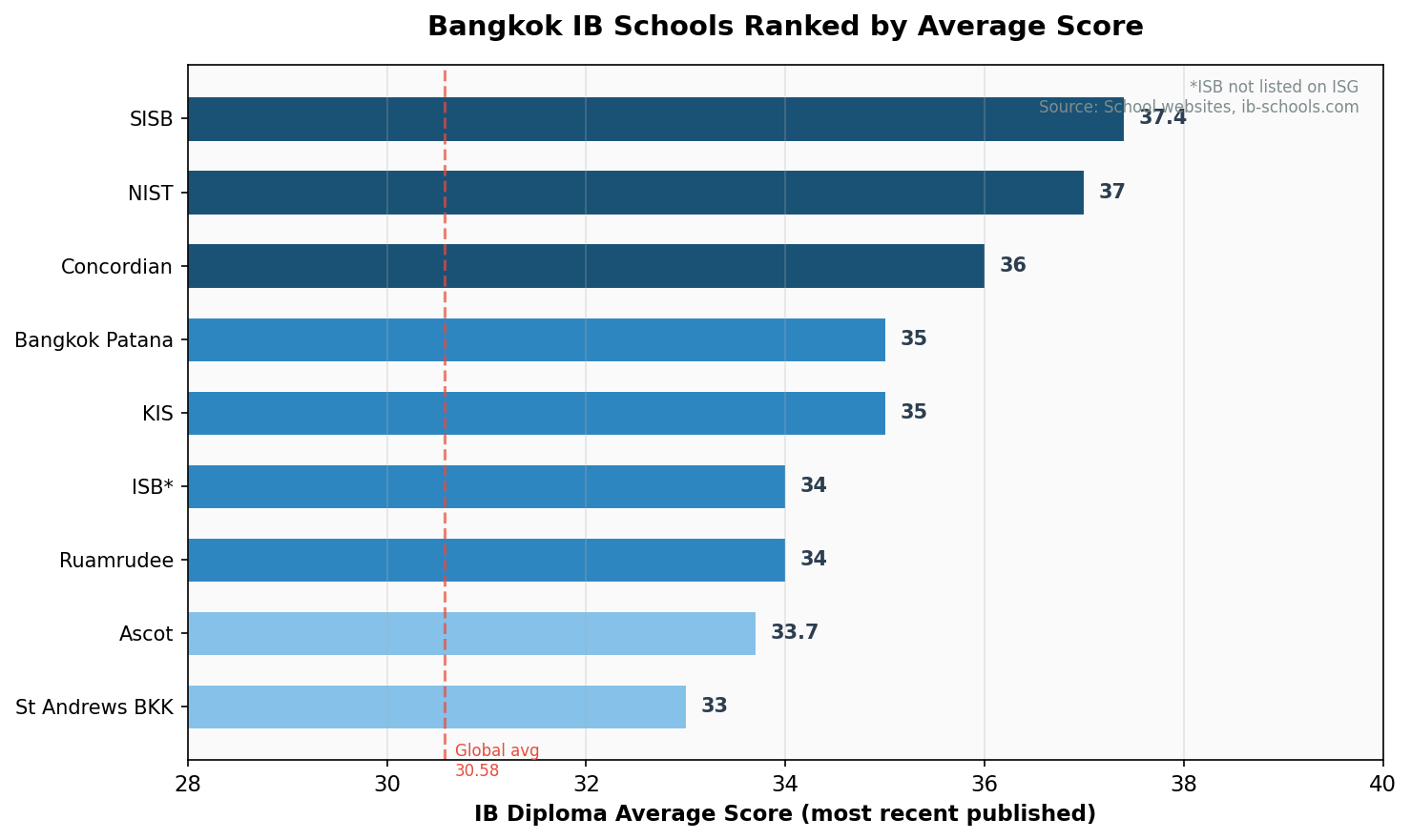
We found published results data for nine Bangkok IB schools. Here they are, ranked by most recent average IB Diploma score.
| Rank | School | Latest Avg | Year | Cohort | Pass Rate | Highest | Fee Range (US$/yr) |
|---|---|---|---|---|---|---|---|
| 1 | SISB | 37.4 | 2022 | ~14 | 100% | 44 | US$11,000-US$23,000 |
| 2 | NIST | 37 | 2025 | ~110 | 100% | 45 | US$18,000-US$31,000 |
| 3 | Concordian | 36 | 2024 | N/A | N/A | N/A | US$18,000-US$28,000 |
| 4= | Bangkok Patana | 35 | 2025 | 128 | 99% | 43 | US$14,000-US$28,000 |
| 4= | KIS | 35 | 2025 | N/A | N/A | N/A | US$13,000-US$27,000 |
| 6= | ISB | 34 | 2025 | 95 | 98% | 44 | ~US$19,000-US$34,000 |
| 6= | Ruamrudee | 34 | 2025 | N/A | 97% | 45 | US$15,000-US$22,000 |
| 8 | Ascot | 33.7 | 2022 | N/A | N/A | N/A | US$8,000-US$17,000 |
| 9 | St Andrews BKK | 33 | 2025 | N/A | 95% | N/A | US$11,000-US$24,000 |
A note on ISB (International School Bangkok): it is Thailand's first international school (est. 1951), with approximately 1,800 students from 60+ nationalities. Its 2026/2027 fees are ฿659,000-฿1,197,000/year (approximately US$19,000-US$34,000). ISB is listed on the International Schools Guide. Fee data drawn from ISB's published schedule.
What the numbers tell you
NIST is the benchmark. A 37-point average on a cohort of 110 students, with a 100% pass rate and two perfect 45s in 2025, is genuinely impressive. This is not a small, cherry-picked group; NIST runs one of the largest IB cohorts in Thailand. It ranks 73rd globally on the ib-schools.com league table (2025 data) and is the only Bangkok school in the top 100. For context, that places it alongside UWCSEA East in Singapore and Dulwich College Shanghai Pudong.
SISB sits at the top of the table with a 37.4 average, but this was its first-ever IB cohort in 2022 with roughly 14 students. A small, self-selected pioneer group tends to skew high. It is a strong signal, not a confirmed pattern. 78.5% of that cohort scored 36 or above, which is remarkable, but the question is whether that holds when the cohort doubles or triples.
Bangkok Patana deserves particular attention. It is academically non-selective and runs 128 students through the Diploma. Posting a 35-point average with 99% pass rate and 20% scoring 40+ on a non-selective cohort of that size is arguably more impressive than higher averages at selective schools with smaller groups. For over a decade, Patana has maintained an average five or more points above the global average. That is consistency, not luck.
Concordian at 36 is strong, and the trilingual angle (English, Chinese, Thai) makes it unusual. Eleven students hit 40+ in 2024. As far as we can tell, it is the only fully trilingual IB school in Thailand.
KIS has a solid track record. Its five-year average sits at 34.5, and it posted 35 in 2025. In 2025, 84% of its Grade 12 students took the full Diploma, which suggests it is not gaming numbers by steering weaker students away from the full programme.
Results vs fees: where is the value?
This is the chart that matters most.
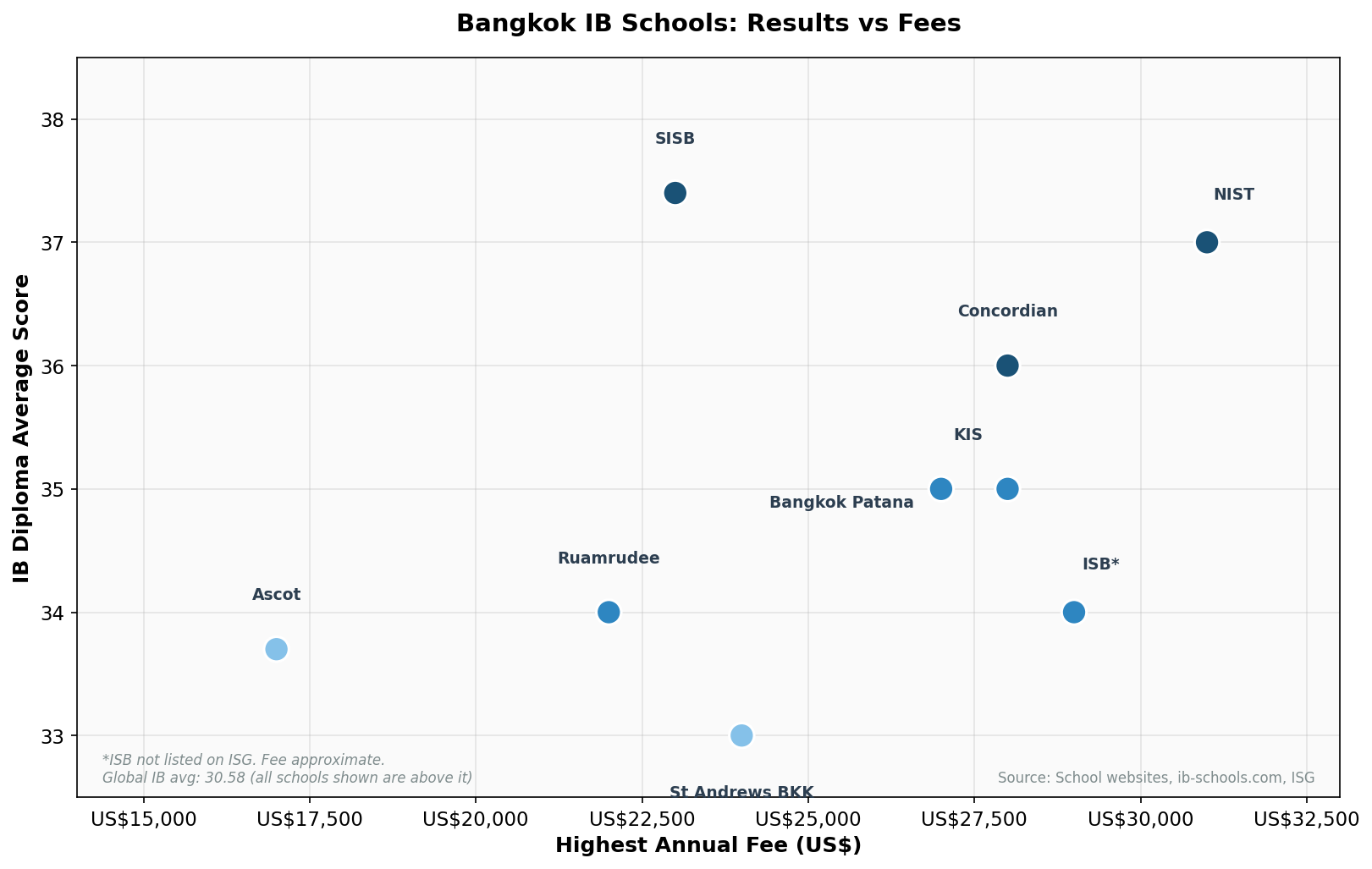
The scatter plot maps each school's highest annual fee against its most recent average IB score. Schools in the top-left are getting you the most IB points per dollar. Schools in the bottom-right are charging premium prices for middling results.
A few observations.
SISB is the standout on value positioning. A 37.4 average at US$23,000 per year places it well above the trend line. If its results hold up across larger cohorts, it will be the obvious recommendation for families who want top results without top-tier fees.
NIST earns its price tag. At US$31,000 per year, it is the most expensive IB school in Bangkok, but it also delivers the highest consistent scores on a large cohort. You get what you pay for.
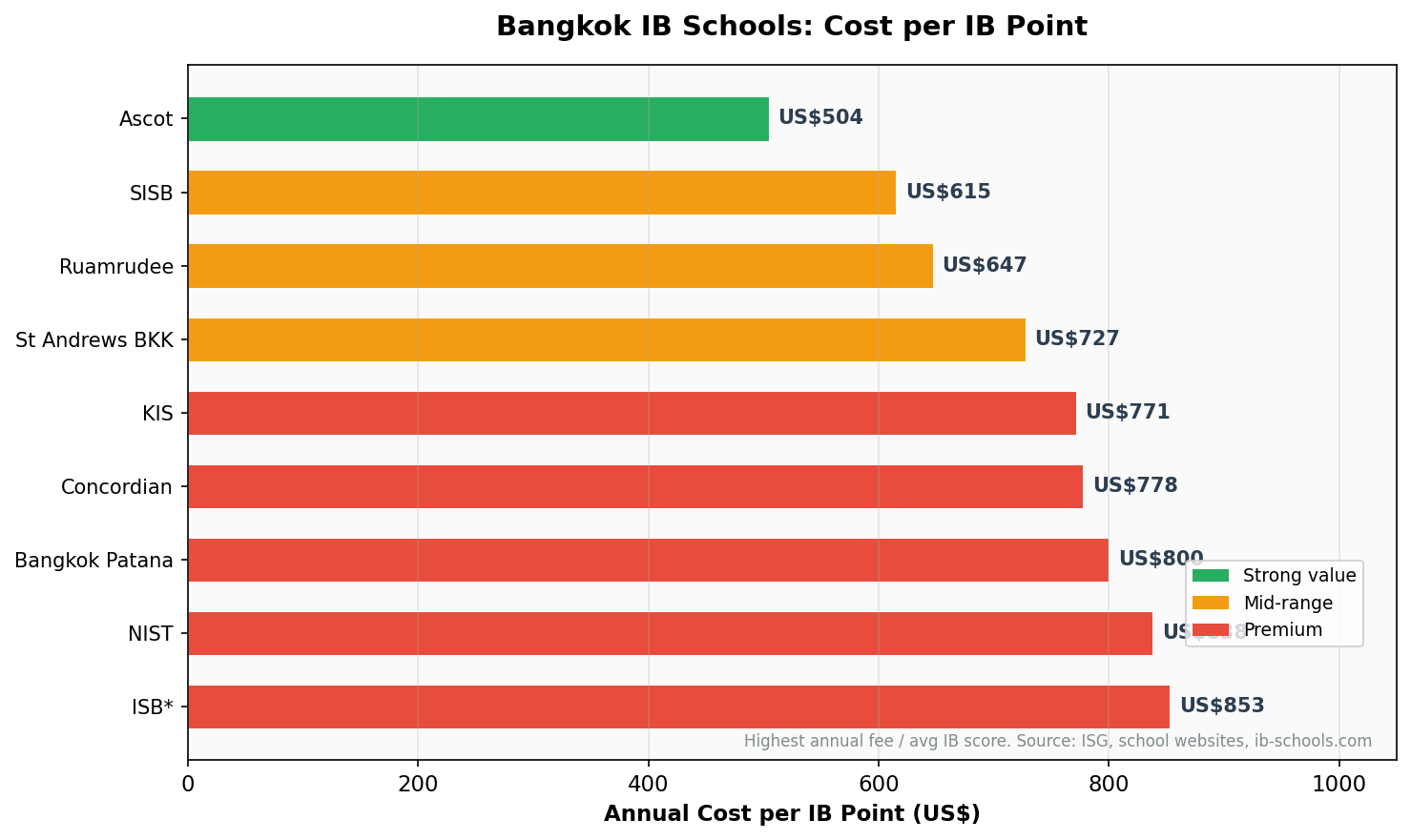
Ascot is the value play. At US$17,000 for the oldest year groups and a 33.7 average, it costs US$504 per IB point. That is roughly 40% less per point than NIST (US$838) or Bangkok Patana (US$800). The trade-off: Ascot's scores are lower, its cohort is smaller, and the campus experience is more modest. But for a family on a tighter budget who still wants the IB pathway, Ascot is the answer the data gives you.
ISB is an outlier in the other direction. At approximately US$34,000 per year for the oldest year groups and a 34-point average, it sits well below the trend line. ISB does publish detailed results - a 98% pass rate, 16% scoring 40+, and a ten-year track record averaging around 35 - so this is not a data problem. It is an excellent school by most measures, and its American-curriculum base with IB and AP overlays appeals to a different demographic. But on a pure results-per-dollar basis, it is the most expensive IB point in Bangkok.
| School | Highest Fee | IB Avg | Cost/Point | Value Tier |
|---|---|---|---|---|
| Ascot | US$17,000 | 33.7 | US$504 | Strong |
| SISB | US$23,000 | 37.4 | US$615 | Strong |
| Ruamrudee | US$22,000 | 34 | US$647 | Mid |
| St Andrews BKK | US$24,000 | 33 | US$727 | Mid |
| KIS | US$27,000 | 35 | US$771 | Premium |
| Concordian | US$28,000 | 36 | US$778 | Premium |
| Bangkok Patana | US$28,000 | 35 | US$800 | Premium |
| NIST | US$31,000 | 37 | US$838 | Premium |
| ISB | ~US$34,000 | 34 | US$1,000 | Premium |
All 17 Bangkok IB schools: fee comparison
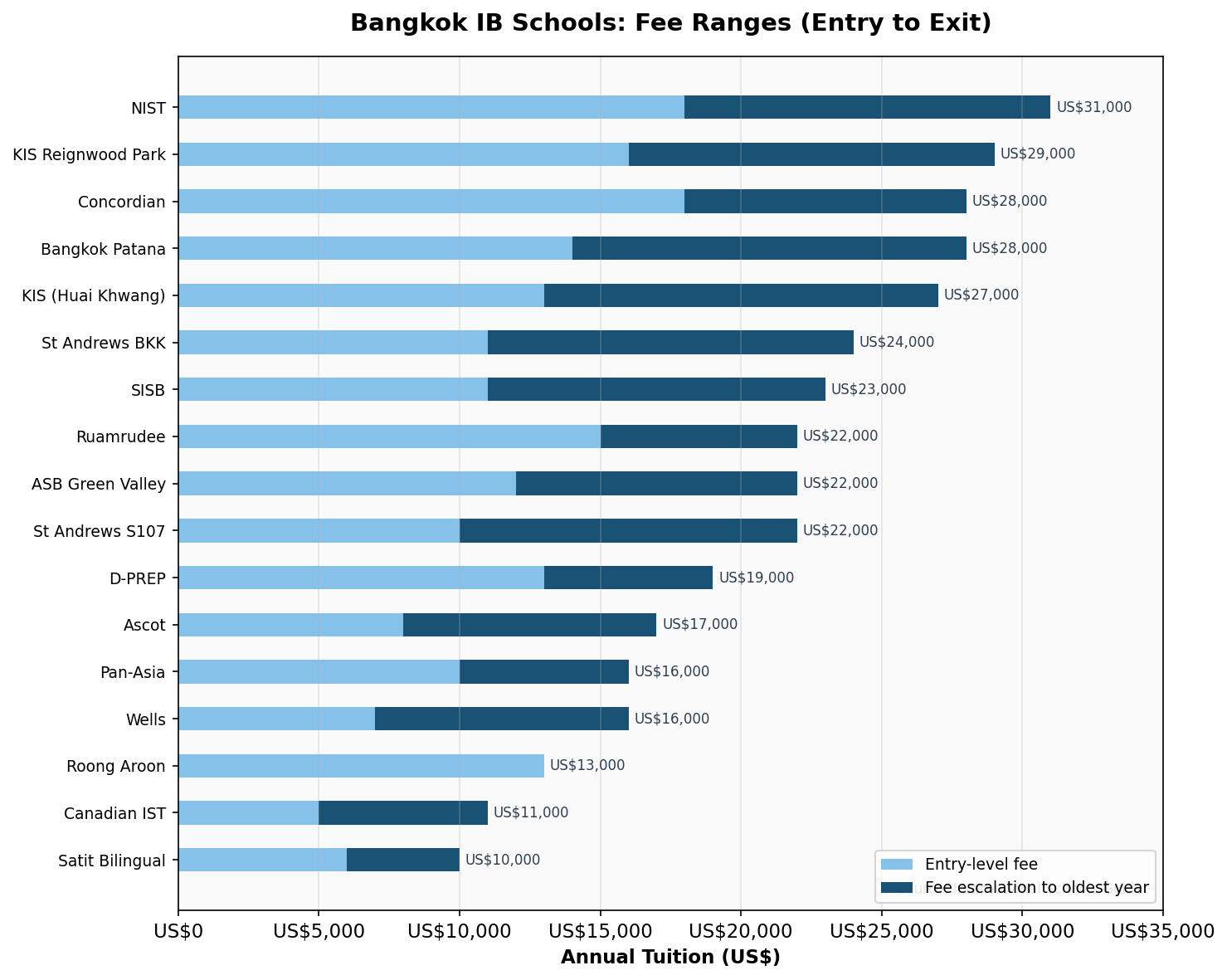
Not all of these schools appear to publish IB results. Several are newer programmes, have small cohorts, or have chosen not to share publicly. The fee data below covers all 17 IB-offering schools listed on the International Schools Guide.
| School | Curriculum | IB Type | Fee Range (US$/yr) | Published Results |
|---|---|---|---|---|
| NIST | IB | Full IB | US$18,000-US$31,000 | Yes (37 avg) |
| KIS Reignwood Park | IB | Full IB | US$16,000-US$29,000 | Joint with KIS HK |
| Concordian | IB | Full IB | US$18,000-US$28,000 | Yes (36 avg) |
| Bangkok Patana | IB/British | IB Diploma | US$14,000-US$28,000 | Yes (35 avg) |
| KIS (Huai Khwang) | IB | Full IB | US$13,000-US$27,000 | Yes (35 avg) |
| St Andrews BKK | IB/British | IB Diploma | US$11,000-US$24,000 | Yes (33 avg) |
| SISB | IB/British | IB Diploma | US$11,000-US$23,000 | Yes (37.4 avg) |
| Ruamrudee | IB | IB Diploma | US$15,000-US$22,000 | Yes (34 avg) |
| ASB Green Valley | IB/American | IB Diploma | US$12,000-US$22,000 | Not found |
| St Andrews S107 | IB/British | IB Diploma | US$10,000-US$22,000 | Not found |
| D-PREP | IB/American | IB Diploma | US$13,000-US$19,000 | Not found |
| Ascot | IB/British | Full IB | US$8,000-US$17,000 | Yes (33.7 avg) |
| Pan-Asia | IB | Full IB | US$10,000-US$16,000 | Partial |
| Wells | IB | Full IB | US$7,000-US$16,000 | Not found |
| Roong Aroon | IB | IB Diploma | US$13,000-US$13,000 | Not found |
| Canadian IST | IB/Canadian | IB Diploma | US$5,000-US$11,000 | Not found |
| Satit Bilingual | IB/British | IB Diploma | US$6,000-US$10,000 | Not found |
We could not find published IB Diploma results for eight of the 17 schools. That does not mean they don't exist - some may share data in prospectuses, parent briefings, or channels we did not access. Some have genuinely small or new programmes (D-PREP was only authorised in 2021). Others, like Wells and Pan-Asia, are well-established but do not appear to publicise their numbers online. Either way, it is a reasonable question to raise during a school visit.
Full IB vs IB Diploma: does it matter?
Five Bangkok schools run the full IB continuum: PYP (Primary Years Programme), MYP (Middle Years Programme), and DP (Diploma Programme). These are NIST, KIS, Concordian, Ascot, and Wells. The rest offer only the two-year IB Diploma in the final years, typically layered onto a British or American curriculum.
The full-IB pathway is the purist's choice. Students who go through PYP and MYP arrive at the Diploma with years of IB methodology baked in. In theory, this should produce better results. In practice, the data does not support that claim. Bangkok Patana (IB/British hybrid) posts a 35 average; Ascot (full IB) posts a 33.7. Concordian (full IB) posts a 36; St Andrews (IB/British) posts a 33. The curriculum pathway matters less than teaching quality, student cohort, and institutional culture.
The more relevant question is whether the school is selective. NIST and SISB are selective in admissions. Bangkok Patana is not. Concordian is moderately so. When comparing IB averages across schools, selectivity is the hidden variable that explains more of the variance than curriculum structure.
How Bangkok compares globally
Bangkok's top IB schools are competitive regionally but do not crack the highest global tiers.
| Benchmark | Avg Score | Source |
|---|---|---|
| Global IB average (2025) | 30.58 | IBO |
| Top school globally (Letovo, Russia) | 43.2 | ib-schools.com |
| Top Bangkok school (NIST) | 37 | SweCham / NIST |
| Tanglin Trust, Singapore | 39.6 | ib-schools.com |
| UWCSEA Dover, Singapore | 36.7 | ib-schools.com |
| ACS Jakarta | 36.1 | ib-schools.com |
NIST at 37 is on par with the mid-tier of Singapore's best. It is below Tanglin Trust (39.6) and NPS International (38.9) but above UWCSEA East (36.1). For a city where maximum school fees are roughly half those in Singapore, that is a creditable showing.
The gap between Bangkok's best (37) and the global elite (43+) is significant. Schools scoring consistently above 40 tend to be highly selective, often boarding, and frequently in markets with deeper pools of academically ambitious families. Bangkok is unlikely to close that gap soon, and probably should not try. The city's strength is breadth and value, not ultra-selectivity.
The schools that don't publish results
We could not find publicly accessible IB results data for Wells, Pan-Asia, Canadian IST, Satit Bilingual, Roong Aroon, ASB Green Valley, St Andrews Sukhumvit 107, or D-PREP. This covers a fee range from US$5,000 to US$22,000 per year, so it is not exclusively a budget-school phenomenon.
Some of these schools have good reasons for not publishing. D-PREP is a new programme with only a few graduating cohorts. Canadian IST and Satit Bilingual operate at the budget end and may not yet have the critical mass of IB students to make averages meaningful. Wells has three campuses and a long history but has focused on AP credentials more than IB marketing.
The question to ask on a visit is straightforward: what were your results last year? Any school offering the IB Diploma should be able to tell you the average score, the number of students who sat the exam, and the pass rate. If they seem reluctant, that matters.
FAQs
What is the highest-scoring IB school in Bangkok? NIST International School, with a 37-point average (Class of 2025) on a cohort of approximately 110 students and a 100% pass rate. SISB posted a higher average (37.4) but on its first cohort of roughly 14 students in 2022, which is too small to draw firm conclusions.
How much do IB schools in Bangkok cost? Annual fees range from US$5,000 (Canadian International School of Thailand) to US$31,000 (NIST) for the oldest year groups. The median for schools with published IB results is around US$24,000-US$28,000. Entry-level fees are lower, typically US$8,000-US$18,000. Fee data from the International Schools Guide.
Which Bangkok IB school offers the best value? On a cost-per-IB-point basis, Ascot International School (US$504 per point) and SISB (US$615 per point) are the strongest performers. Ascot charges US$17,000 per year for the oldest year groups and averages 33.7; SISB charges US$23,000 and averaged 37.4 on its first cohort. Ruamrudee (US$647 per point) is the best value among the mid-range schools with a 34 average at US$22,000.
Is Bangkok Patana academically selective? No. Bangkok Patana is explicitly non-selective and runs one of the largest IB cohorts in Bangkok (128 students in 2025). Its 35-point average and 99% pass rate on a non-selective intake makes it one of the more creditable IB results in the city.
How does Bangkok compare to Singapore for IB results? Bangkok's top school (NIST, 37 avg) sits between Singapore's mid and upper tier. Tanglin Trust leads Singapore at 39.6, and NPS International at 38.9. NIST is above UWCSEA East (36.1). Bangkok's maximum IB fees (US$31,000) are roughly half Singapore's top end (US$39,000+), making it significantly better value per IB point.
How we compiled this data: Fee data covers 17 Bangkok IB schools with published fee ranges, sourced from the International Schools Guide. IB results data is sourced from school websites, social media announcements, IBO statistical bulletins, and the ib-schools.com global league table. Where schools report multiple years of results, the most recent published figure is used. ISB (International School Bangkok) is included for context but is not listed on the International Schools Guide; its fee data is approximate. "Cost per IB point" divides the highest annual fee by the average IB Diploma score. All figures are approximate USD equivalents. Fees correct as of March 2026. Exchange rate: THB 35.6 = US$1 (March 2026).
We work hard to make every figure, date and description on this page accurate. We don't always get it right. If you spot an error, a fee that's changed, a fact that's out of date, something we've got wrong, please tell us. Use the feedback button above or email us directly. We'll check it and update the article.